Tankless Water Heater Leaking? 5 Sources and How Urgent Each One Is
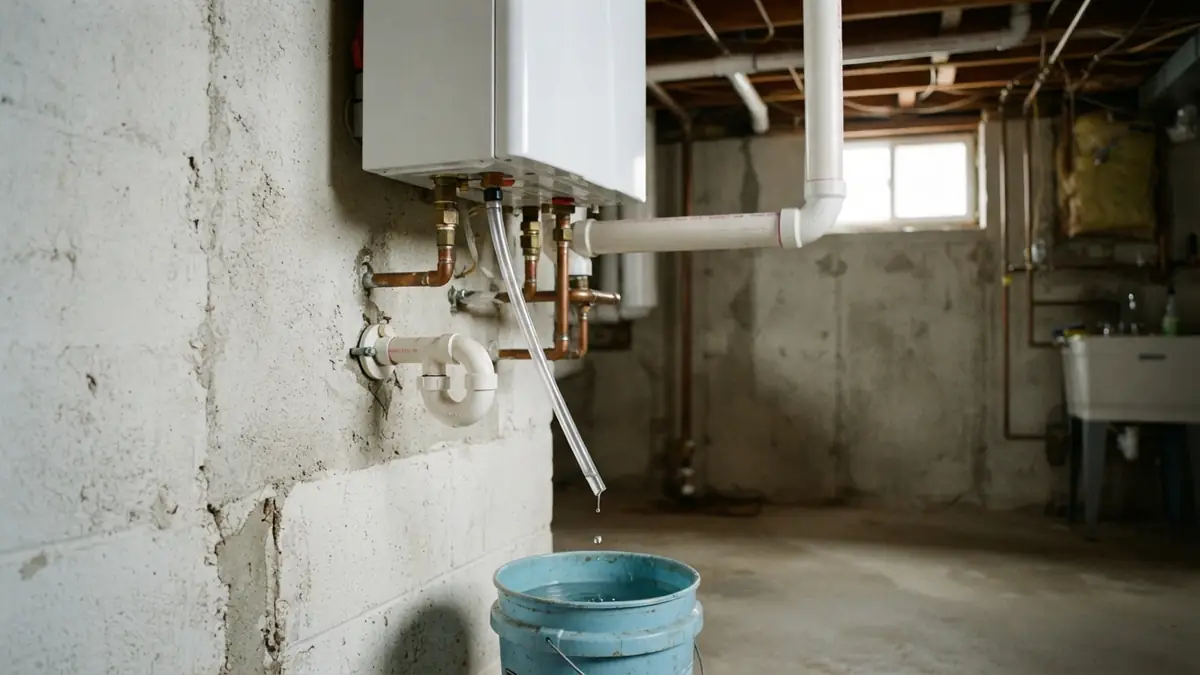
A tankless water heater leaking is less likely to flood a room than a leaking tank, because there is no tank full of water to let go. That does not make it harmless. Water around a gas burner, a fan and a circuit board is a reason to act quickly, and a couple of the sources are more serious than they look.
Five sources follow, with how urgent each one is. Before you look closely, switch the unit off at its power switch, and if water is still getting out, close the cold water valve under the unit. If you smell gas, leave the house and phone the gas utility from outside. To have the leak traced, book a technician.
1. The service valves and their caps
The hot and cold isolation valves under the unit have stems and caps, and they get handled during every flush. A cap that was not seated properly, or a stem that has started to weep, drips slowly onto whatever is below. Wipe it dry and watch it for a minute. A weeping stem usually means the valve is replaced, which is a plumber's job. Urgency: low, but fix it before the drip reaches the unit.
2. The pipe connections under the unit
The fittings where the house pipes meet the unit can loosen or corrode. Look for wet joints, green crust or stained pipe. A steady drip at a fitting needs a plumber to reseat or replace it. One owner whose old copper line was already corroded saw it start to seep after a vinegar descale, so check the connections after every flush. Urgency: moderate.
3. The relief valve
Many units have a pressure relief valve. When it drips or runs, either the valve is worn or the pressure behind it is too high. Never cap or plug it. A plumber should find out which. Urgency: moderate, and higher if the flow is steady.
4. The condensate line
Condensing units vent in PVC and make acidic condensate that needs a drain, often through a neutralizer. A little water at that drain while the unit runs is normal. A disconnected, blocked or cracked line is not, and neither is a brass fitting that has corroded, which is why one plumber's advice is to swap a brass adapter for PVC. A blocked condensate drain can also shut the unit down with a code. Urgency: moderate, because acidic water on a floor or wall does damage over time.
5. The heat exchanger or its gasket
Water coming from inside the cabinet, or from the body of the unit, can mean the heat exchanger or a gasket around it has failed. Water quality is the usual cause: an owner with two failed exchangers in four years was told exactly that. One HVAC technician has also reported heat exchanger gasket failures that leaked water and carbon monoxide into the cabinet, and a cracked exchanger can let combustion gases into places they should not be.
Treat this one as urgent. Switch the unit off, close the cold valve and call. If a carbon monoxide alarm sounds, leave the house and call emergency services. Urgency: high.
How to tell which one you have
Water on the floor beside the unit with a dry cabinet is usually a plumbing leak, from a valve, a connection or the relief valve. Water inside the cabinet, or on the circuit board side, is a unit leak. Drips that only show while the unit runs point at the condensate line. A leak that goes on for weeks does far more damage than one caught on day one, so do not wait to see whether it stops.
What a leak repair costs
A valve or connection fix sits inside the estimated $150 to $800 range for part repairs, and a diagnosis visit is estimated at $100 to $250. A heat exchanger replacement is estimated at $1,000 to $2,500. Gas tankless units commonly last 20 years or more with maintenance, so a leak on a younger unit is normally worth repairing. On an older unit with an exchanger leak, the five repair-or-replace questions help you decide. A regular flush is the best protection for the exchanger.
Quick answers
Why is my tankless water heater leaking from the bottom?
Usually a service valve, a pipe connection, the relief valve or the condensate line. Water from inside the cabinet can mean the heat exchanger or its gasket, which is urgent.
What would cause a tankless water heater to leak?
Worn valves, loose or corroded connections, a relief valve under pressure, a condensate line problem, or a failed heat exchanger or gasket, often from scale and poor water quality.
Is it normal for a tankless water heater to drip condensate?
Condensing units make condensate and send it to a drain, so some water there while the unit runs is normal. Water anywhere else is not.
My tankless water heater's heat exchanger is leaking. What should I do?
Switch the unit off, close the cold water valve and call a technician. Do not run it. If a carbon monoxide alarm sounds, leave the house and call emergency services.
Still no hot water?
A technician who works on tankless units can test it and price the fix in writing.